Quick answer
A professional wildfire risk assessment reviews the roof, gutters, vents, exterior walls, windows, doors, eaves, decks, Zone 0, defensible space, accessory structures, utilities, and red flag readiness. Allied Disaster Defense uses a 47-point inspection framework aligned with IBHS Wildfire Prepared Home concepts, the 2025 Wildfire Prepared Home Technical Standard, and California ignition-resistant construction principles. The homeowner should receive a prioritized action plan, not a vague warning.
Who needs a wildfire risk assessment?
A wildfire risk assessment is useful for any homeowner in a high fire threat area, but it is especially important when a property is near a canyon, slope, open space, dry brush, mature trees, or a neighborhood that has seen recent fire activity. In Southern California, that can include foothill communities, canyon-adjacent homes, hillside lots, and neighborhoods exposed to Santa Ana winds.
It is also valuable when insurance pressure increases, when you are buying or renovating a home, when you have older vents or wood features, or when you want to prioritize a limited hardening budget. A homeowner can spend money quickly on visible projects while still missing small ignition points. The assessment is meant to prevent that.
CAL FIRE’s home hardening and defensible space guidance makes the same larger point: wildfire survival is not only about clearing brush. It is about reducing ignition risk around the home and improving the structure’s ability to resist ember exposure. IBHS Wildfire Prepared Home guidance adds a practical standard for what a more resilient home should include.
What gets reviewed
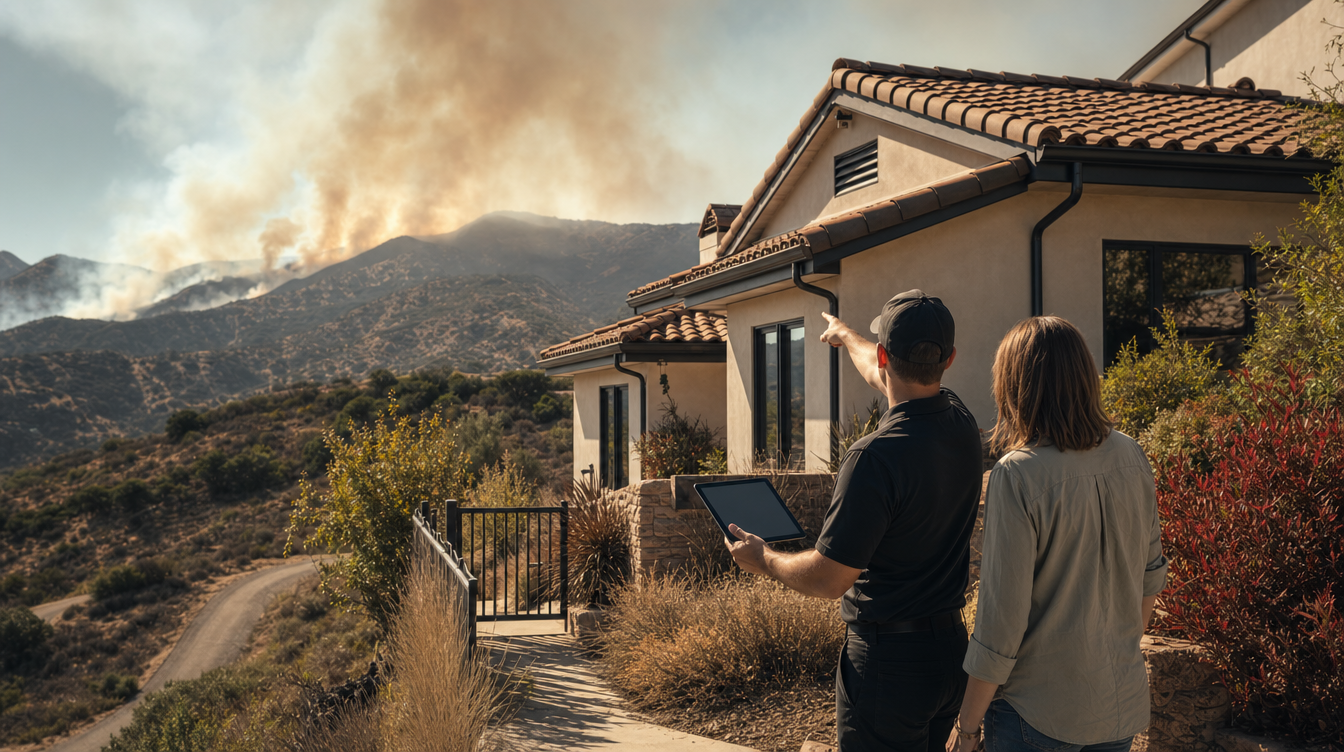
A complete assessment looks at how the whole property behaves during fire weather. The inspector should not only look at the hillside or the plants. The structure itself matters. So do the small connections between the structure and the landscape.
- Roof system: roof class, debris, valleys, penetrations, tile openings, flashing, and maintenance.
- Gutters and downspouts: noncombustible materials, debris buildup, downspout condition, and gutter guards where appropriate.
- Vent protection: attic, crawlspace, gable, eave, soffit, and dryer vents.
- Exterior walls and siding: ignition resistance, wall-base clearance, combustible contact, and sealed penetrations.
- Windows and doors: tempered glass, multi-pane windows, garage seals, weather stripping, and skylight exposure.
- Eaves, soffits, and overhangs: enclosed or ignition-resistant construction, gaps, and debris collection.
- Decks, patios, and attachments: deck materials, underside protection, combustible storage, furniture, pergolas, and fence connections.
- Zone 0: the 0 to 5 foot noncombustible or low-fuel area around the home.
- Defensible space: the 5 to 30 foot area, plus vegetation spacing and dead fuel removal.
- Accessory structures and utilities: sheds, ADUs, propane tanks, and clearance around equipment.
- Maintenance and preparedness: red flag readiness, evacuation prep, ongoing vegetation work, and movable combustibles.
ADD’s 47-point inspection framework
Allied Disaster Defense uses an IBHS and Wildfire Prepared Home inspired 47-point wildfire inspection checklist. The list is not a generic form. It is a way to organize what we see on the property so homeowners can understand the difference between immediate cleanup, routine maintenance, product upgrades, and larger hardening work.
The categories align closely with the 2025 Wildfire Prepared Home Technical Standard, the IBHS homeowner checklist, and California CBC Chapter 7A ignition-resistant construction principles for wildfire-prone areas.
- Roof System, points 1 to 6: Class A roof covering, no wood shake or combustible roofing, roof free of leaves and pine needles, ember stops on barrel tile or corrugated roofs, protected roof valleys, and sealed roof penetrations.
- Gutters and Downspouts, points 7 to 10: noncombustible gutters, noncombustible downspouts, clear gutters, and gutter guards or screens where applicable.
- Vent Protection, points 11 to 16: attic vents, crawlspace vents, gable vents, eave and soffit vents, mesh openings at 1/8 inch or smaller where applicable, and dryer vents with proper flap closure.
- Exterior Walls and Siding, points 17 to 20: ignition-resistant or noncombustible siding, 6-inch noncombustible wall-base clearance, no combustible materials touching siding, and sealed wall penetrations.
- Windows and Doors, points 21 to 25: multi-pane tempered windows, solid-core or noncombustible exterior doors, intact weather stripping, functional garage door seals, and dual-pane or tempered skylights where applicable.
- Eaves, Soffits, and Overhangs, points 26 to 29: enclosed or ignition-resistant eaves, compliant soffits, no gaps at rafter tails or eave intersections, and overhangs free of combustible debris.
- Decks, Patios, and Attachments, points 30 to 35: ignition-resistant or compliant decking, underside protection where needed, no combustible storage under decks, spacing around pergolas and gazebos, minimized or noncombustible deck furniture, and a compliant 0 to 5 foot zone around deck connections.
- Zone 0, points 36 to 40: no combustible mulch within five feet, no vegetation touching the structure, no firewood or combustible storage within five feet, noncombustible fencing attached to the home, and groundcover such as gravel, concrete, pavers, or mineral soil.
- Defensible Space, points 41 to 44: maintained grass height, properly spaced shrubs, separated tree canopies, and removed dead vegetation.
- Accessory Structures and Utilities, points 45 to 46: cleared and separated propane tanks, and detached sheds or ADUs that meet spacing and hardening requirements.
- Maintenance and Preparedness, point 47: red flag warning readiness through debris removal, relocation of movable combustibles, evacuation preparation, and ongoing vegetation maintenance.
This framework lets us show homeowners the difference between a quick fix and a high-priority hardening issue. Cleaning gutters is not the same kind of project as replacing vents, but both can matter. Removing cushions from a deck is not the same as rebuilding a deck, but it can still change exposure during a wind event.
What you should receive afterward
The assessment should result in a clear written plan. A homeowner should know what to do first, what can wait, and what needs a contractor or specialist. The best reports separate low-cost cleanup from larger hardening upgrades.
Useful deliverables include photos, risk notes, priority ranking, recommended materials, maintenance timing, and a plan for the next red flag warning. The report should also explain why each item matters. A homeowner does not need a long list of scary statements. They need a decision tool.
For example, a report might identify roof debris, a vulnerable gable vent, bark mulch against stucco, a wood fence connection, and patio furniture against a sliding door. Those issues do not all have the same cost or urgency. The assessment should rank them so the homeowner can start with the highest-risk and most realistic fixes.
ADD field note
One ADD case study shows why the assessment matters. A homeowner started with a $1,500 wildfire assessment in March 2024, then completed a $40,000 hardening contract a few months later. During the January 2025 Eaton fire, the home survived and later needed $18,000 in smoke and soot remediation. That was about $59,500 in total work over 10 months, with the assessment creating the roadmap. We also worked first hand during the Palisades fire and serviced many homes with long-term fire retardant, which reinforced that readiness decisions have to be made before the fire is at the neighborhood edge.
Common findings in Southern California
In Southern California, the most common risks are not always dramatic. Many are ordinary maintenance and design issues that become serious under wind.
- Leaves and needles packed into roof valleys or gutters.
- Bark mulch against stucco, siding, or wood trim.
- Wood fencing attached directly to the house.
- Patio furniture, cushions, and outdoor rugs stored against walls.
- Plants touching windows, vents, doors, or eaves.
- Dry side yards hidden behind gates.
- Vents with inadequate ember resistance or damaged screening.
- Garage door seals that leave ember-entry gaps.
- Deck undersides used for combustible storage.
- Address numbers or access routes that are difficult to see under smoke, wind, or night conditions.
These issues are common because homes were often designed for comfort, privacy, curb appeal, and shade, not ember exposure. The goal of the assessment is not to criticize the property. It is to translate fire science and field experience into a manageable plan.
Where long-term fire retardant fits
Long-term fire retardant can be part of a broader wildfire defense plan, but it should not be treated as a substitute for home hardening, Zone 0, defensible space, vent protection, or evacuation readiness. Retardant is a tactical layer. The structure and the property still need to be prepared.
ADD’s field experience during the Palisades fire included servicing many homes with long-term fire retardant. That work reinforced an important lesson: product applications are strongest when they sit on top of preparation, not in place of it. A home with clogged gutters, combustible storage, and vulnerable vents still has avoidable risks. A prepared home can make a retardant plan more meaningful because the highest-risk fuel paths have already been reduced.
For homeowners, the right question is not “Do I need retardant or hardening?” The better question is “What layers make sense for this property?” An assessment helps answer that by looking at the house, the surrounding fuels, the likely ember pathways, and the homeowner’s goals.
Why the assessment can pay for itself
The value of an assessment is prioritization. Without it, homeowners often spend money on visible landscaping while missing vents, roof debris, fence connections, or the first five feet around the home. A good assessment can reduce wasted effort and help direct the budget toward the items most likely to matter.
It can also support better conversations with contractors, insurance representatives, HOA boards, family members, and neighbors. A homeowner with a written priority list is in a stronger position than a homeowner with a vague sense that the property is “probably risky.”
For insurance-related conversations, documentation can also matter. An assessment is not a guarantee of coverage or premium changes, but it can help show that the homeowner is actively identifying and reducing wildfire exposure. As California insurance conditions continue to change, that kind of documentation may become increasingly useful.
Get a clear wildfire readiness plan for your property
Allied Disaster Defense provides wildfire risk assessments for Southern California homeowners who want a practical, prioritized roadmap before peak fire weather.
Sources and further reading
FAQ
How long does a wildfire risk assessment take?
Timing depends on the size and complexity of the property. Most homeowner assessments focus on the exterior structure, immediate defensible space, access, and priority hardening opportunities.
Is a wildfire risk assessment only for homes near brush?
No. Homes away from heavy brush can still face ember exposure from nearby fires, wind-carried debris, fences, landscaping, vents, roofs, decks, and neighboring properties.
What should I do after the assessment?
Start with the highest-priority, lowest-complexity items first: Zone 0 cleanup, gutter and roof debris removal, combustible storage relocation, and obvious ember-entry issues. Then schedule larger hardening projects in priority order.
Does a wildfire assessment include fire retardant recommendations?
It can. Long-term fire retardant may be recommended as one layer of protection, but it should be considered alongside home hardening, defensible space, vent protection, maintenance, and evacuation readiness.