Quick answer
The Spokane Complex fires in Washington destroyed roughly 700 structures and forced about 65,000 people to evacuate in under 48 hours, driven by wind gusts the National Weather Service reported at 30 to 45 mph. The lesson for California property owners is that wind-driven ember exposure, not direct flame contact, is what puts most homes at risk, and that the work which changes an outcome has to be finished before a warning is issued. Start with Zone 0, roof and gutter debris, ember-resistant vents, decks and fencing, and defensible space. A wildfire risk assessment turns that general list into a ranked, property-specific plan.
This article covers an active incident. Figures below were verified on August 4, 2026 and will change as the fires progress. Residents in the affected area should follow Spokane County emergency alerts and local fire officials for evacuation instructions, not this page.
What happened in Spokane
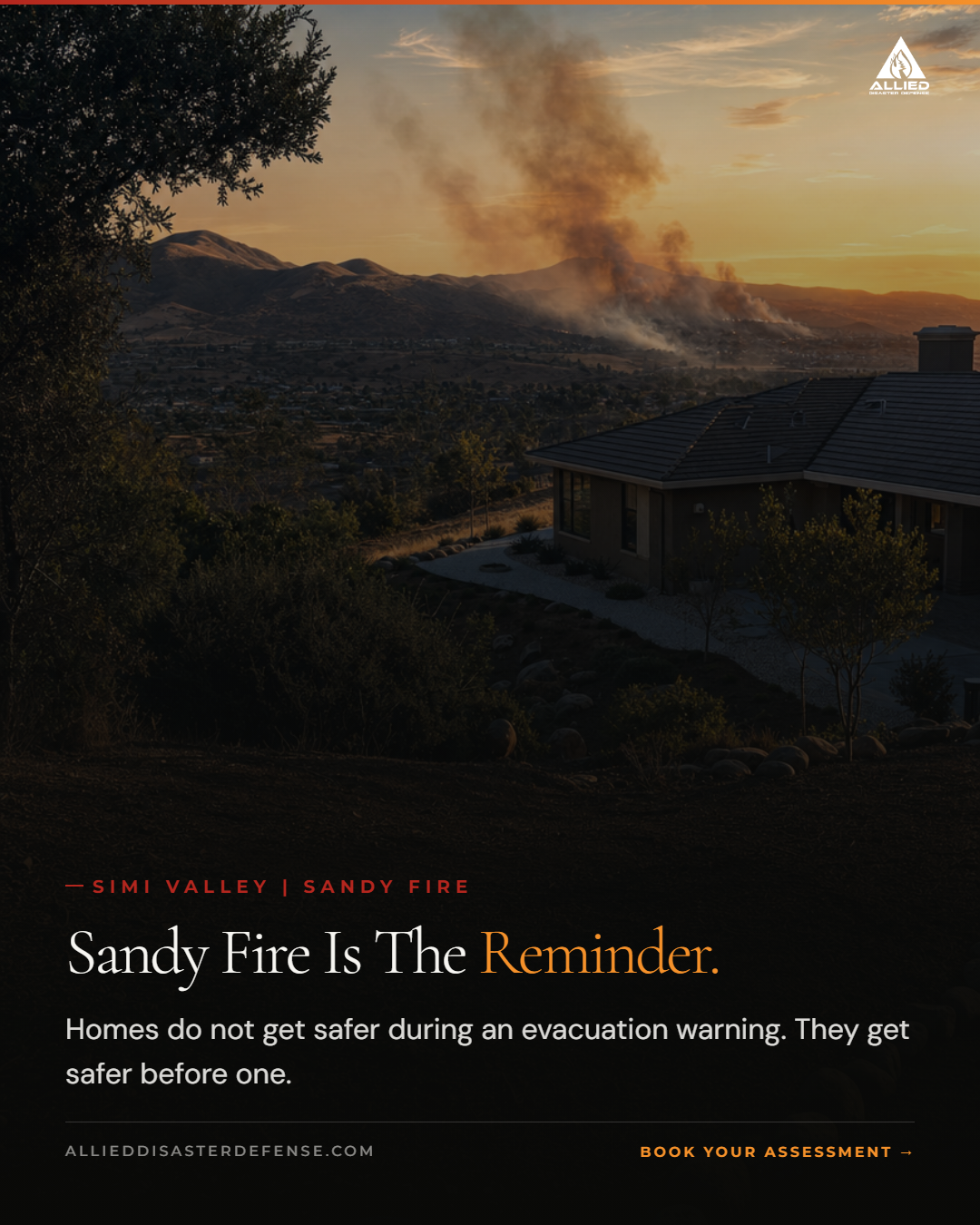
Beginning August 1, 2026, three fires burned into populated areas around Spokane, Washington. Fire officials grouped them as the Spokane Complex: the Old Trails Fire, the Fairview Fire, and the Autumn Lane Fire. Reporting on August 3 put the combined footprint at roughly 8,000 acres with 0% containment, about 700 structures destroyed, and approximately 65,000 residents under evacuation orders. The Old Trails Fire alone accounted for about 640 of the destroyed structures. Spokane’s mayor described it as the worst natural disaster the region has faced.
The conditions will look familiar to anyone who has worked a California wind event. The National Weather Service reported sustained winds of 15 to 25 mph with gusts between 30 and 45 mph, layered on top of drought-dried fuels and low humidity. The fires did not stay in the wildland. They moved into neighborhoods, and once structures began to burn, each burning building became a source of new embers for the homes around it.
That progression is the part worth studying. A fire that reaches a subdivision stops behaving like a forest fire and starts behaving like a structure-to-structure fire. Acreage becomes a poor measure of damage. Roughly 8,000 acres is not a large fire by California standards. The January 2025 Palisades fire burned close to three times that. Yet the structure loss in Spokane was severe because of where the fire went and how fast the wind pushed it there.
Why homes burn without direct flame contact
The most common misconception about wildfire is that flames have to reach a house to destroy it. Research from the Insurance Institute for Business and Home Safety and post-fire investigations by CAL FIRE consistently point the other direction. Wind-driven embers are responsible for a large share of structure ignitions, and those embers can land well ahead of the visible fire front.
Embers do not need a dramatic entry point. They accumulate in the ordinary places:
- Dry bark mulch and planting beds against the foundation
- Wood fences that connect directly to the structure
- Deck boards, and combustible storage underneath decks
- Roof valleys, gutters, and debris caught near skylights or penetrations
- Attic, gable, eave, soffit, crawlspace, and dryer vents
- Patio cushions, umbrellas, doormats, and trash bins against exterior walls
- Sheds, trellises, and ornamental vegetation touching the building
A property can go the entire event without a flame front arriving at the property line and still be lost to a dozen small ignitions happening at once. This is why home hardening and Zone 0 work matters as much as brush clearance on the slope. The structure and the space immediately around it have to be addressed together.
What a “particularly dangerous situation” warning actually means
Ahead of these fires, the National Weather Service issued what was reported as the first ever “particularly dangerous situation” Red Flag Warning for central and eastern Washington. That tag is not routine language. It is reserved for conditions forecasters believe are capable of producing extreme, fast-moving fire behavior, and it is used sparingly enough that its first appearance in a region is itself news.
Here is the operational problem for a property owner. That warning arrived hours before the fires, not weeks. By the time a warning of that severity is issued, the useful window for preparation has already closed. Contractors are booked. Crews are committed to life safety. Roads may close. Retardant application, vent replacement, and vegetation work are no longer schedulable. The only things still available are evacuation and whatever was already done.
California homeowners will recognize the pattern from Santa Ana and Sundowner wind events. The warning is the last checkpoint, not the starting line.
Why waiting is the biggest risk
Most property owners begin looking for wildfire protection after a major fire is in the news. That timing is understandable and it is also the least effective moment to start.
Every wildfire season in California follows the same curve. Interest spikes during an active incident, mitigation capacity is fully committed at exactly that moment, weather windows for treatment shrink, and the properties that end up prepared are the ones whose owners made decisions months earlier during unremarkable weather.
Preparation is not about eliminating risk. No property is fireproof and no service can make one. It is about reducing the number of ways a property can ignite, and doing it while there is still time to choose what gets fixed first.
ADD field note
Allied Disaster Defense works from a 47-point wildfire inspection framework aligned with IBHS Wildfire Prepared Home concepts, the 2025 Wildfire Prepared Home Technical Standard, and California CBC Chapter 7A ignition-resistant construction principles. We review roof systems, gutters, vents, siding, windows, doors, eaves, decks, Zone 0, defensible space, utilities, accessory structures, and red flag readiness.
Two things from our own field work inform how we talk about timing. During the January 2025 Palisades fire we were dispatched for a member whose estate sat in the fire’s path, and the response grew into servicing entire neighborhoods and pockets of neighborhoods across the Palisades for seven days straight. Separately, on a Malibu hillside estate we treat every year, about $9,000 of long-term retardant went down across the property’s priority risk zones weeks before the December 2024 Franklin Fire. When the fire moved up toward the property, it stopped at the treated hillside near the tennis courts. No single factor decides whether a fire stops or a structure survives. The treatment was in place before conditions turned, and the property was not starting from zero when it mattered.
A layered wildfire protection strategy
No single product or service determines whether a home survives. The properties that hold up best combine several measures, in a deliberate order.
1. Wildfire risk assessment
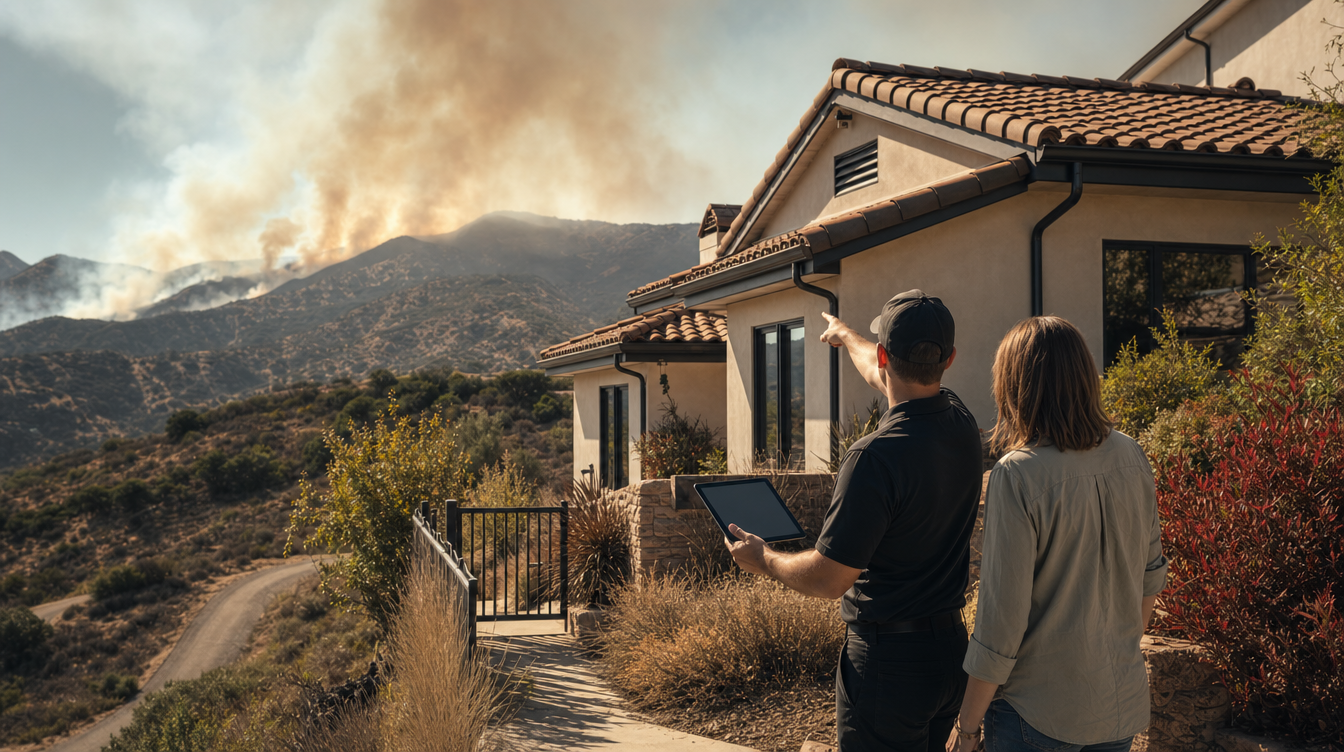
Every property has a different set of weak points. An assessment identifies ignition pathways, ember exposure, slope and wind influence, vegetation hazards, access constraints, and the sequence in which items should be addressed. The value is less in finding problems, which owners can often spot themselves, and more in ranking them. What matters this week, what can wait, what needs a licensed contractor, and what is simply maintenance.
2. Zone 0 and defensible space
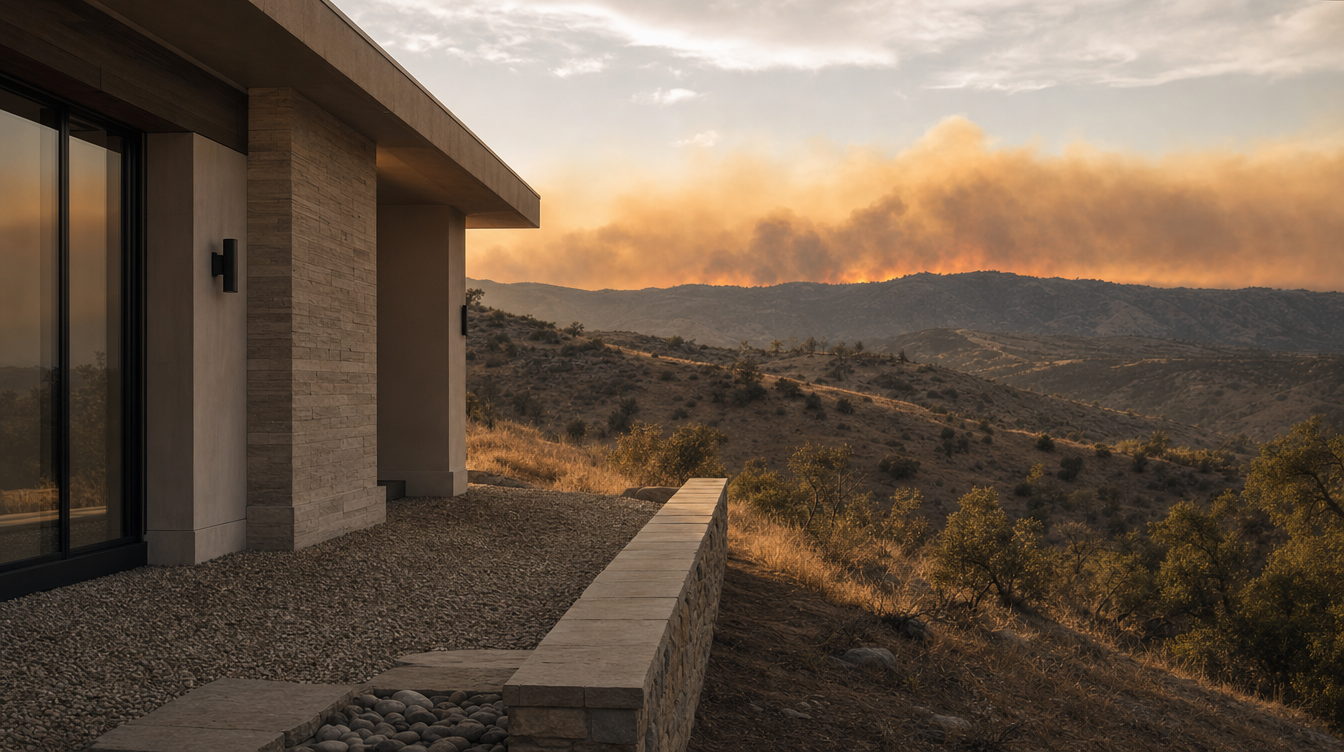
Clear the first five feet around the structure of combustible material: bark mulch, firewood, dead leaves, cushions, storage, and plants touching walls or vents. Beyond that, manage grass height, remove dead vegetation, break up continuous shrub masses, limb up trees, and reduce ladder fuels. California’s Zone 0 requirements continue to move toward stricter near-structure standards, so work done now is unlikely to be wasted.
3. Home hardening
Upgrading vulnerable components changes outcomes measurably. Ember-resistant vents, noncombustible gutters kept clear, Class A roofing maintained free of debris, metal mesh screening, sealed eaves, and a noncombustible strip immediately adjacent to the structure all reduce the number of available entry points.
4. Long-term fire retardant
Professional retardant application reduces the ignitability of treated vegetation in strategic locations. For properties with significant vegetation exposure or open-space adjacency, it adds a layer on top of the preceding three. It does not replace any of them.
Where long-term fire retardant fits
Long-term retardants are formulated to reduce the ignitability of vegetation after application. Unlike water, which evaporates within hours, long-term retardant remains on treated vegetation until weathering or meaningful rainfall reduces its effectiveness. Typical treatment areas include hillsides, native vegetation, fence lines, fuel corridors, ornamental landscaping, tree lines, open-space interfaces, and defensible-space zones.
The honest framing is this. Retardant is a layer, not a solution, and it is at its most useful on a property where the basics are already handled. A treated hillside does not compensate for a debris-filled gutter, an unscreened attic vent, or firewood stacked against the house. Applied as part of a plan, on a property that has already reduced its near-structure fuel, it is a meaningful addition. Applied as a panic purchase during an active incident, it is usually too late to schedule at all.
What Southern California should take from this
Spokane and Southern California have different landscapes, different fuel types, and different fire seasons. What they share is the mechanism: seasonal drought, wind-driven fire behavior, expanding wildland-urban interface, and neighborhoods built close enough that one burning structure threatens the next.
Whether a property sits in Malibu, the Palisades, Beverly Hills, the San Gabriel Valley, Orange County, the Inland Empire, or Ventura County, the exposure pattern repeats. Hillside lots, dry chaparral, ornamental landscaping, attached wood fencing, narrow side yards, and seasonal wind events. The Spokane Complex is a reminder that a fire does not need to be historically large to take hundreds of homes. It needs wind, dry fuel, and a neighborhood that was not ready.
What to do this month
If this event prompted you to look at your own property, do the walk now, in daylight, while conditions are calm.
- Clear the first five feet around the structure completely.
- Remove leaves and needles from gutters, roof valleys, drains, decks, and side yards.
- Move patio furniture, cushions, trash bins, and stored material away from exterior walls.
- Inspect attic, crawlspace, gable, eave, soffit, and dryer vents for ember entry points.
- Check where wood fencing attaches to the house, and clear out what is under the deck.
- Trim any vegetation touching walls, windows, eaves, or the roofline.
- Review evacuation supplies, medications, documents, chargers, and pet needs.
- Photograph the areas that concerned you, so conditions can be compared later.
- Schedule a wildfire risk assessment if you want the list ranked for your specific property.
If you share a fence line, a slope, or an open-space edge with neighbors, talk to them. A well-prepared home can still be exposed by the shed, fence, tree canopy, or unmanaged side yard next door. In neighborhood fires, the block prepares together or it does not really prepare at all.
Know what to fix before the next Red Flag Warning
Allied Disaster Defense provides wildfire risk assessments for California homeowners, estates, HOAs, and commercial property owners who want a clear, prioritized plan while there is still time to act on it.
Sources and further reading
- NBC News: Spokane Complex structure loss and evacuations
- Washington State Standard: Fires destroy hundreds of structures in Spokane
- National Weather Service: Fire Weather and Red Flag Warnings
- CAL FIRE: Home Hardening
- CAL FIRE: Defensible Space
- IBHS: Wildfire Prepared Home
- 2025 Wildfire Prepared Home Technical Standard
FAQ
Do the Spokane fires actually apply to California properties?
The landscape differs, but the mechanism does not. Wind-driven embers, drought-dried fuels, and homes built close together produced the losses in Spokane, and those same three factors drive structure loss in California wind events.
Can a home be lost if flames never reach it?
Yes. Wind-driven embers can travel well ahead of the fire front and ignite mulch, gutters, vents, decks, fencing, and stored material. Many structures are lost to multiple small ember ignitions rather than a flame front.
Is long-term fire retardant a substitute for defensible space or home hardening?
No. Retardant reduces the ignitability of treated vegetation and works as one layer within a broader plan. It does not offset debris-filled gutters, unscreened vents, or combustible material against the structure.
Should I wait for a Red Flag Warning before preparing?
No. By the time a warning is issued, contractors are committed, weather windows have closed, and crews are focused on life safety. Preparation should be finished before fire weather arrives.
What does a wildfire risk assessment actually produce?
A property-specific, ranked list of vulnerabilities and recommended actions, covering the roof system, gutters, vents, siding, windows and doors, eaves, decks, Zone 0, defensible space, accessory structures, utilities, and access.