Fire Retardant

Long-Term Fire Retardant Application for Wildfire Readiness

Professional ground-applied retardant service for homeowners who want another layer in their wildfire readiness plan.
Long-Term Fire Retardant Application for Wildfire Readiness
Quick Answer
Long-term fire retardant can help reduce ignition potential on treated vegetation and materials when used correctly, but it is not a substitute for defensible space, home hardening, maintenance, or evacuation planning. Allied Disaster Defense evaluates where treatment makes sense, how weather and site conditions affect application, and how retardant fits into a broader wildfire readiness plan.
Why It Matters

Retardant works best as a layer.

Placement

Application areas matter

Treatment should be planned around exposure, fuels, slope, and property access.

Weather

Conditions matter

Rain, irrigation, growth, and site conditions affect maintenance and reapplication decisions.

Plan

It is not a standalone fix

Retardant should support, not replace, Zone 0, vents, gutters, and defensible space.

What Allied Disaster Defense Reviews

What Allied Disaster Defense reviews before application.

Site

Exposure and access

Allied Disaster Defense reviews target areas, equipment access, slope, and vegetation conditions.

Scope

Treatment plan

The plan identifies where retardant can be applied and what should be cleared first.

Maintenance

Reapplication needs

Homeowners get practical guidance on inspection and seasonal readiness.

Field Application

Additional Layer of Defense

This is not a silver bullet, but is meant to be an additional layer of defense above and beyond traditional methods such as home hardening and vegetation management.

Long-term fire retardant application
Process

How the process works.

1

Review property conditions

Confirm where treatment makes sense and whether prep is needed.

2

Prepare the service area

Move items, clear obstructions, and confirm access.

3

Apply retardant

Use professional application methods for the approved treatment areas.

4

Maintain readiness

Document the service and plan future checks around weather and season.

Field Proof

Allied Disaster Defense has worked first-hand around active wildfire conditions.

Allied Disaster Defense has serviced homes with long-term retardant during high-risk fire periods, including field work connected to Palisades fire conditions.
FAQ

Questions homeowners ask.

Does retardant make my home fireproof?

No. It is one mitigation layer and should be paired with defensible space, home hardening, and evacuation readiness.

How long does it last?

Longevity depends on product, exposure, weather, irrigation, growth, and site conditions.

Should I get an assessment first?

Yes. Assessment helps decide where retardant fits and what should be fixed before application.

Long-Term Fire Retardant Packages | Allied Disaster Defense
Allied Disaster Defense
Long-Term Fire Retardant Packages

Which retardant package fits your property?

Enter your property details to generate a retardant readiness profile, compare Silver, Gold, and Platinum Shield coverage levels, then submit the selected package for internal review. Our team confirms fit first, then sends an invoice to finalize and schedule.

Retardant is one mitigation layer. It does not make a home fireproof and does not guarantee wildfire, insurance, or coverage outcomes.
1
Property Fit
2
Packages
3
Review

Find the Right Retardant Package

Answer a few property questions first so we can show useful package options instead of a generic price list.

Quick package finder

This form estimates your starting package, shows the coverage difference between Silver, Gold, and Platinum, and carries your address into the final review step. No checkout is collected here.

2minutes
Get matchedWe use property type, terrain, vegetation, and urgency to recommend a starting package.
See coverageThe next step visually compares 30, 60, and 90 gallon treatment areas.
No blind checkoutWe review fit first, then send an invoice if the package makes sense.
Please enter your street address
We use this to personalize the package profile and prefill the final review step.
Required
Required
Required
Required
Required
Required
Required
Required
Required
Required
Check any that fit. You can skip this if you are not sure.

Analyzing your retardant coverage profile

We are matching your address, vegetation load, fuel pathways, timing, and coverage goal to the right starting package.

A Your property Added to profile
  • Mapping property location, terrain, and wildfire exposure
  • Estimating vegetation coverage volume and treatment priority zones
  • Building Silver, Gold, and Platinum package comparison
Auto-advancing in 5s

Recommended Starting Package

Based on your initial retardant risk profile, here is the package we would start with before technician review.

Initial Retardant Risk Profile Gold Shield
LowerElevatedUrgent
Profile TierElevated
Treatment FocusPerimeter fuels
Priority WindowSchedule soon

What we are analyzing

This is a quick purchasing profile. It does not replace a full wildfire assessment, but it helps identify where retardant could add value before a technician reviews the property.

Geographic ExposureHigh-risk area
Fire Activity SignalSeasonal readiness
Regional ImpactWind-driven ember exposure
Insurance ContextMitigation documentation helpful
Embers
High
Radiant heat
Moderate
Direct flame
Moderate

Retardant use case

Prioritize vegetation and fuel pathways where long-term retardant can add a temporary treatment layer before fire weather.

Scheduling signal

Earlier scheduling gives the crew more flexibility before access, wind, or active incidents limit safe application windows.

Technician review

We still confirm slope, vegetation density, access, and product fit before sending the invoice or scheduling the application.

Vulnerabilities

We look for vegetation, fences, slopes, and access points where treatment could reduce available fuel around the home.

Climate Timing

High wind, dry vegetation, and Red Flag timing can make early application more valuable than waiting until smoke is nearby.

Protection Plan

The package is a starting point. After review, we confirm product fit, send the invoice, then schedule the application once finalized.

What you are buying

This is not a generic estimate. The selected package tells us how much long-term retardant to reserve, where the first treatment zones should be prioritized, and whether your property needs a larger custom scope.

  • Long-term fire retardant application volume matched to your property profile.
  • Technician review before invoicing so the package is not blindly scheduled.
  • Coverage planning around vegetation, perimeter fuels, slopes, fences, decks, access points, and timing.
  • Clear invoice next step so you can finalize the package without waiting through a long estimate cycle.

Why act before fire weather

Retardant is easiest to schedule when access is safe, weather is workable, and the crew can review the property before urgent demand spikes.

1. ProfileAddress and risk details determine the starting package.
2. ReviewWe confirm whether the selected package makes sense.
3. FinalizeInvoice finalizes the package before scheduling.

Coverage level demo

Gold Shield expands from priority fuels into the broader perimeter treatment area.
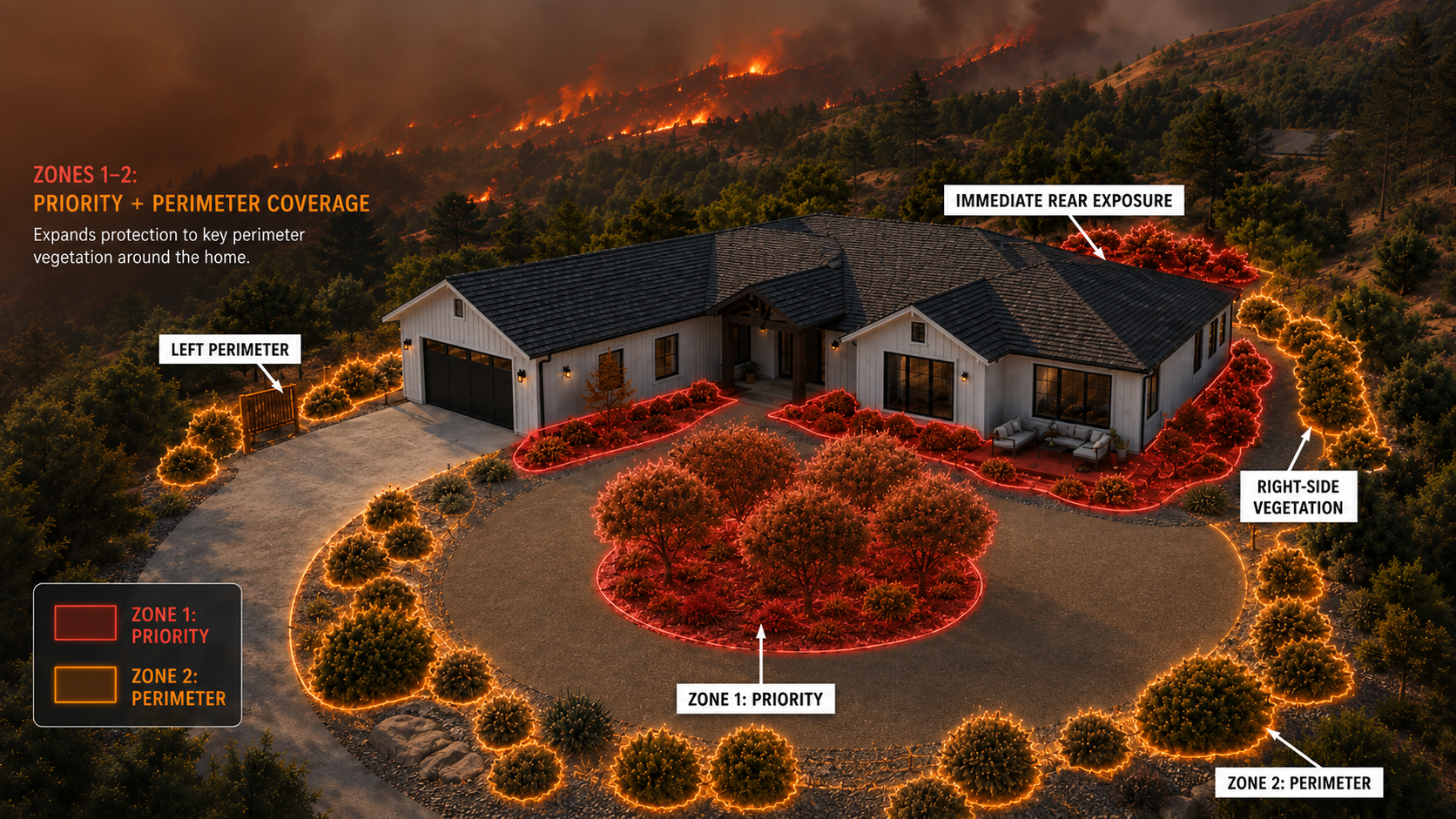
Gallons60
Planning Area6,000 sq ft
Best FitBroader perimeter
Gold Shield demo showing priority and perimeter retardant coverage zones

Tap a package to preview the planned treatment area before continuing.

Priority fuelsNear-home vegetation, shrubs, fence lines, deck-adjacent fuel, and key access points.
Perimeter fuelsBroader ornamental vegetation, side yards, driveway edges, and extended defensible areas.
Slope exposureHillside or canyon-side vegetation where more volume may be needed.
Technician reviewFinal application area depends on vegetation density, slope, access, weather, and product suitability.
Selected
Silver Shield
Essential Protection
$3,500
30 application gallons covers about 3,000 sq ft of vegetation at planning rate
  • Smaller properties
  • Focused treatment areas
  • Lower fuel loads
Selected
Gold Shield
Enhanced Protection
$4,500
60 application gallons covers about 6,000 sq ft of vegetation at planning rate
  • Most popular package
  • 2x gallons for about $1,000 more
  • Strong value for many homes
Selected
Platinum Shield
Premium Protection
$5,300
90 application gallons covers about 9,000 sq ft of vegetation at planning rate
  • Larger properties
  • Heavy vegetation
  • Broadest retardant treatment area

Custom Protection

For estate properties, HOAs, commercial properties, multi-structure sites, or properties that need more than 90 gallons.

Custom pricing

Your selected starting package

PackageGold Shield
Total$4,500
Planning Area6,000 sq ft

Gold is the best-value starting point for many homes because it doubles treatment volume for about $1,000 more than Silver. We still review the property before invoicing.

Before we schedule

1

We check the profile, address, vegetation, access, and selected coverage level.

2

If the package fits, we send an invoice for that package total.

3

After the invoice is finalized, we schedule application and discuss whether a full wildfire risk assessment makes sense.

Important: This initial risk profile is a sales and planning aid, not a full wildfire assessment or guarantee of protection. Coverage estimates assume roughly 1 application gallon per 100 sq ft of treatable vegetation. Actual coverage varies by vegetation type, density, slope, access, weather, and product suitability. Retardant does not replace Zone 0, defensible space, ember-resistant vents, gutter maintenance, or evacuation planning.

No checkout is collected on this page. Submit the package for review first.

Submit Your Package for Review

We will review your initial retardant risk profile and selected package quickly. If everything fits, we will send an invoice for the selected package total so you can finalize and schedule the application.

1
Selected package: Gold Shield
This routes to the long-term retardant path with your profile score, risk drivers, and package selection. After review, the next step is an invoice for the selected package total, then scheduling.
Required
Required
Enter a valid email
Enter a valid phone number
Property address from step 1

Allied Disaster Defense

Request received, there.

We will review your initial retardant risk profile, selected package, and property details very quickly. If the package fit looks right, we will send over an invoice for the selected total before scheduling the application.

What happens next

1
We quickly review your profile score, selected package, property address, access, timing, and treatment notes.
2
We send an invoice for the selected package total after confirming the package fit.
3
After the invoice is finalized, we schedule the application with you and discuss whether a wildfire risk assessment makes sense.